


Two networks shared the top spots in RFBENCHMARK’s July ranking. T-Mobile recorded the highest average download and upload speeds on both 5G and 4G LTE, while Orange won both latency categories. The highest average download speed reached 484.3 Mbps, recorded on T-Mobile’s 5G network.
How did Play and Plus compare? In which categories were the operators closely matched, and where were the gaps more pronounced? The July ranking examines data transfer speeds and network response times separately. We compare the results of four operators using measurements collected throughout the month.
READ ALSO: 5G/4G LTE mobile internet in Poland – the 2025 annual review
RFBENCHMARK methodology – how was the July ranking compiled?
RFBENCHMARK rankings use measurements taken by users of its mobile app. Data collected through this model, known as crowdsourcing, reflects connections under everyday network usage conditions. The analysis covers three metrics: download speed, upload speed and latency, commonly known as ping.
The ranking covers the period from July 1 to 31, 2026 and includes 230,664 individual measurement results across the measured parameters. The largest share of the dataset came from 4G LTE, with 123,402 results, or 53.50% of the total. 5G accounted for 106,364 results, representing 46.11%. The remaining 898 results, or 0.39%, came from older technologies, which are not covered in detail in this report.
The largest number of results came from Orange, with 79,433 (34.44%). It was followed by Play with 69,290 (30.04%), Plus with 42,058 (18.23%) and T-Mobile with 39,883 (17.29%). Percentages have been rounded.
These counts represent the combined number of download, upload and latency measurement results, rather than the number of unique users or complete speed tests. The shares attributed to operators and technologies refer solely to the collected dataset; they do not indicate market share or network coverage.
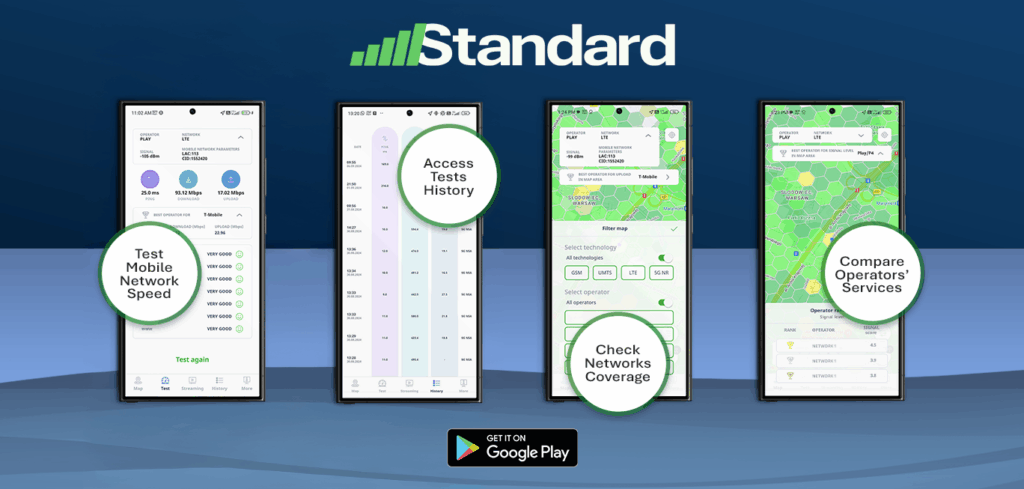
Want to help us compile future rankings? Download our free mobile app and join the community!
Mobile internet in Poland (July 2026)
5G results
Average download speed: T-Mobile (484.3 Mbps)
In July’s 5G measurements, the highest average download speed was recorded by T-Mobile at 484.3 Mbps. It was the only operator to exceed 400 Mbps. Orange came second with 382.3 Mbps. Play took third place at 265.9 Mbps, followed by Plus at 126.1 Mbps.
The gap between T-Mobile and Orange was 102.0 Mbps. This means the leader’s average was approximately 26.7% higher than the runner-up’s result. Orange also held a clear lead over the next operator, outperforming Play by 116.4 Mbps.
Average upload speed: T-Mobile (66.5 Mbps)
The operators ranked in the same order for upload speeds as they did for downloads. T-Mobile averaged 66.5 Mbps, ahead of Orange at 61.5 Mbps and Play at 55.6 Mbps. Plus came fourth with 27.4 Mbps.
The gaps between the top three networks were much smaller here than in the download category. T-Mobile outpaced Orange by 5.0 Mbps, while Orange recorded a result 5.9 Mbps higher than Play. A larger gap separated third and fourth place: Play’s result was slightly more than twice Plus’s average.
Lowest average ping: Orange (21.9 ms)
In the latency category, Orange took the lead with an average ping of 21.9 ms. Play came second at 24.7 ms, followed by T-Mobile at 24.9 ms. Plus recorded 27.2 ms.
Orange beat its closest competitor by 2.8 ms. Play and T-Mobile were particularly close, separated by just 0.2 ms. Average 5G latency remained below 30 ms across all four operators.
4G LTE results
Average download speed: T-Mobile (70.3 Mbps)
On 4G LTE, T-Mobile won the download category with an average of 70.3 Mbps. It was followed by Orange at 54.5 Mbps, Play at 45.7 Mbps and Plus at 41.9 Mbps. The operators therefore ranked in the same order as on 5G.
T-Mobile’s result was 15.8 Mbps, or approximately 29.0%, higher than Orange’s. The two lower-ranked networks were closer together, with 3.8 Mbps separating Play and Plus. This was a much smaller gap than the one between these operators in 5G download speeds.
Average upload speed: T-Mobile (23.0 Mbps)
The highest average LTE upload speed was recorded by T-Mobile at 23.0 Mbps. Orange and Play both achieved 21.8 Mbps, sharing second place when results are rounded to one decimal place. Plus recorded 17.7 Mbps.
The leading operators were closely matched in this category. The gap between the leader and Orange and Play was 1.2 Mbps, while the difference between the highest and lowest averages across all four operators was 5.3 Mbps. In July’s LTE results, T-Mobile’s advantage over its closest competitors was therefore more pronounced for downloads than for uploads.
Lowest average ping: Orange (29.2 ms)
Orange also led the latency measurements on the fourth-generation network. Its average ping was 29.2 ms, the only result below 30 ms in this part of the ranking. Play came second at 30.5 ms, ahead of T-Mobile at 31.7 ms. The highest average latency was recorded on the Plus network at 38.5 ms.
Orange beat Play by 1.3 ms and T-Mobile by 2.5 ms. The gap between first and last place was 9.3 ms. As with 5G, the operator with the highest data transfer speeds did not also win the ping category.
5G/4G LTE results table
| 5G | ||||
|---|---|---|---|---|
| Mierzony parametr | Orange | Play | Plus | T-Mobile |
| Szybkość pobierania danych | 382,3 Mbps | 265,9 Mbps | 126,1 Mbps | 484,3 Mbps |
| Szybkość wysyłania danych | 61,5 Mbps | 55,6 Mbps | 27,4 Mbps | 66,5 Mbps |
| Ping | 21,9 ms | 24,7 ms | 27,2 ms | 24,9 ms |
| Liczba pomiarów | 38324 | 30187 | 18896 | 18957 |
| LTE | ||||
|---|---|---|---|---|
| Mierzony parametr | Orange | Play | Plus | T-Mobile |
| Szybkość pobierania danych | 54,5 Mbps | 45,7 Mbps | 41,9 Mbps | 70,3 Mbps |
| Szybkość wysyłania danych | 21,8 Mbps | 21,8 Mbps | 17,7 Mbps | 23,0 Mbps |
| Ping | 29,2 ms | 30,5 ms | 38,5 ms | 31,7 ms |
| Liczba pomiarów | 41109 | 39090 | 22279 | 20924 |
Help us compile our report on mobile internet service quality and speeds in Poland!
Download our free mobile app and join the community!
Recommended connection parameters for smooth use of online services
| Szybkość pobierania [Mbps]: | ||||||
|---|---|---|---|---|---|---|
| Rodzaj usługi | od 0.1 do 0.3 | od 0.3 do 1 | od 1 do 2 | od 2 do 6 | powyżej 6 | Ping |
| Gry sieciowe czasu rzeczywistego | Poniżej 30 ms | |||||
| Skype rozmowy i VoIP | Poniżej 150 ms | |||||
| Skype rozmowy wideo / udostępnianie ekranu | Poniżej 150 ms | |||||
| Skype grupowe rozmowy wideo (3 osoby) | Poniżej 150 ms | |||||
| Przeglądanie stron WWW | Poniżej 200 ms | |||||
| Poniżej 200 ms | ||||||
| Gry sieciowe inne | Poniżej 200 ms | |||||
| YouTube wideo w jakości 480p, inne serwisy jakość SD | Poniżej 200 ms | |||||
| YouTube wideo w jakości HD | Poniżej 200 ms |
Example access times for online services at different download speeds
| Szybkość pobiernia | |||||
|---|---|---|---|---|---|
| Rodzaj usługi | 0.3 Mbps | 1 Mbps | 2 Mbps | 6 Mbps | |
| Otwarcie strony WWW (www.notelit.pl – 1,2 MB) | 32 s | 10 s | 5 s | 2 s | Czas dostępu do usługi |
| Pobranie wiadomości e-mail z załącznikami (5 MB) | 133 s (2min) | 40 s | 20 s | 7 s | Czas dostępu do usługi |
| Pobranie mapy Warszawy w Google Maps (3,4 MB) | 91 s | 27 s | 14 s | 5 s | Czas dostępu do usługi |
| Załadowanie gry flash (3 MB) | 80 s | 24 s | 12 s | 4 s | Czas dostępu do usługi |
| Załadowanie strumienia audio z serwisu Wrzuta (6:09 – 10 MB) | 267 s (4 min) | 80 s | 40 s | 13 s | Czas dostępu do usługi |
| Załadowanie strumienia video Full HD z serwisu YouTube (2:33 – 40MB) | 1067 s (18 min) | 320 s (5 min) | 160 s (3 min) | 53 s | Czas dostępu do usługi |
| Pobranie pliku z serwera FTP (100 MB) | 2667 S (44 min) | 800 s (13 min) | 400 s (7 min) | 133 s (2 min) | Czas dostępu do usługi |







Leave a Comment
Your email address will not be published. Required fields are marked with *