

February 2026 on the Polish telecommunications market was marked by T-Mobile’s lead in the average data download speed categories and Orange’s increasingly strong position as the leader in low latency. Although 5G technology is nipping at the heels of older technology, the 4G LTE standard still constitutes the foundation of mobile connectivity in Poland.
READ ALSO: Mobile Internet in Poland 5G/4G LTE – the great 2025 summary
The ranking was created based on an analysis of 365,293 measurements. The detailed breakdown of tests by technology is as follows:
- 4G LTE: Remains the most popular standard with 187,283 tests (approx. 51.3% of all measurements).
- 5G: Accounts for 176,735 tests (approx. 48.4%), which shows that nearly every second speed test is already conducted using the latest technology.
- Older technologies represent a marginal percentage of the market, generating only 1,275 measurements (approx. 0.3%).
In the structure of the tests conducted, Orange (32.7%) and Play (31.6%) customers led the way, generating nearly two-thirds of all traffic together. A smaller share of measurements was recorded for the Plus (18%) and T-Mobile (17.6%) networks.
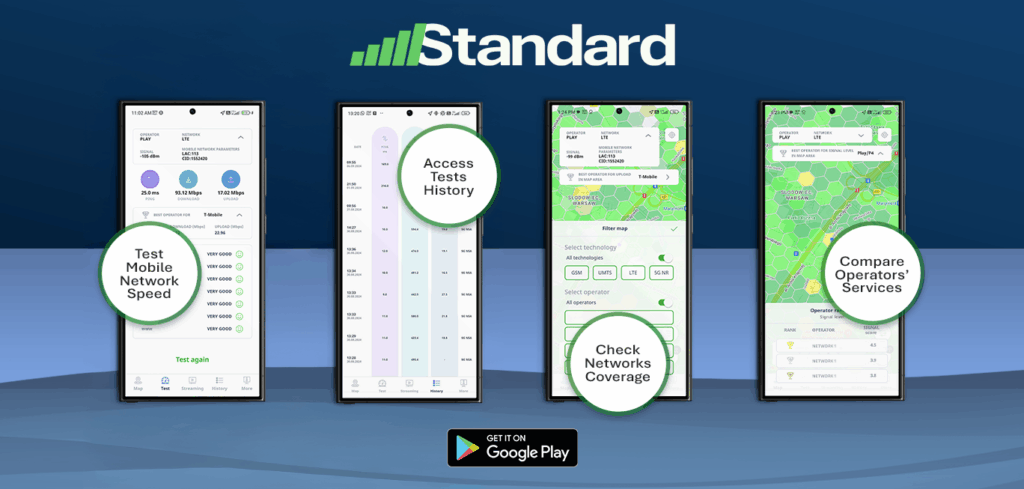
Want to help create future rankings? Download our mobile app for free and join the community!
Mobile Internet in Poland – what was the situation in January 2026?
In January 2026, in 5G network tests, T-Mobile achieved the highest average data download speed (447.3 Mbps), outpacing Orange by 67.1 Mbps. The results of the other operators, Play and Plus, were significantly lower, at 236.7 Mbps and 126.0 Mbps, respectively. In the data upload category, differences at the top were minor – T-Mobile reached 65.9 Mbps, ahead of Orange by less than 5 Mbps. The best network responsiveness was recorded by Play, with the lowest ping result of 22.4 ms.
In the 4G LTE standard, T-Mobile again provided the highest download throughput (64.3 Mbps), ahead of Orange by nearly 16 Mbps. The data upload category featured the most even competition, where Play (23.9 Mbps) beat T-Mobile by only 0.2 Mbps. Regarding latency, Orange achieved the most favorable parameter (27.9 ms). The greatest distance to the competition in LTE technology was recorded by Plus, whose ping results (37.9 ms) lagged behind other operators by 10 ms.
See what mobile Internet looked like in January 2026
Mobile Internet in Poland (February 2026)
5G Results
Average data download speed: T-Mobile (429.1 Mbps)
T-Mobile remains the undisputed leader with a result of 429.1 Mbps. Orange (374.9 Mbps), second in the ranking, trails the winner by over 50 Mbps, which is still an impressive result, allowing for instant consumption of 8K video content. Further places are held by Play (233.5 Mbps) and Plus (119.6 Mbps), which lags significantly behind the field.
Average data upload speed: T-Mobile (64.1 Mbps)
In the upload category, which is crucial for content creators and remote workers, the competition is very close. T-Mobile (64.1 Mbps) slightly leads Orange (62.0 Mbps). Play (54.8 Mbps) also recorded a solid result, while Plus (28.2 Mbps) offers speeds half as fast as the rest of the competition.
Lowest ping value: Orange (21.9 ms)
For gamers, the most important information is that Orange offers the lowest latency at 21.9 ms. Right behind it are Play (22.7 ms) and T-Mobile (23.4 ms). Even Plus (25.4 ms), closing the field, offers parameters in 5G technology that allow for comfortable online gaming.
4G LTE Results
Even though the industry’s eyes are on 5G, over 187,000 tests in the 4G LTE standard show that it is still the most important technology for the majority of Poles.
Average data download speed: T-Mobile (64.7 Mbps)
T-Mobile maintained the crown with a result of 64.7 Mbps. The competition for second place took place between Orange (49.0 Mbps) and Play (44.8 Mbps). Plus (41.4 Mbps) closes the list. Differences between operators in LTE are much smaller than in the case of 5G.
Average data upload speed: T-Mobile (23.9 Mbps)
In the LTE data upload category, there is a minor difference between T-Mobile (23.9 Mbps) and Play (23.7 Mbps). Orange is close behind with a result of 22.4 Mbps, and Plus again records the weakest result (18.7 Mbps).
Lowest ping value: Orange (28.5 ms)
In fourth-generation networks, Orange again recorded the lowest ping (28.5 ms). It is worth noting that latency in 4G is about 7-8 ms higher than in 5G technology, which clearly indicates that upgrading equipment to the newer standard has a real impact on network responsiveness. The next places were taken by T-Mobile (29.5 ms) and Play (29.6 ms), with Plus (37.2 ms) closing the list.
5G/4G LTE Results Table
| 5G | ||||
|---|---|---|---|---|
| Mierzony parametr | Orange | Play | Plus | T-Mobile |
| Szybkość pobierania danych | 374,9 Mbps | 233,5 Mbps | 119,6 Mbps | 429,1 Mbps |
| Szybkość wysyłania danych | 62,0 Mbps | 54,8 Mbps | 28,2 Mbps | 64,1 Mbps |
| Ping | 21,9 ms | 22,7 ms | 25,4 ms | 23,4 ms |
| Liczba pomiarów | 58642 | 55745 | 31129 | 31219 |
| LTE | ||||
|---|---|---|---|---|
| Mierzony parametr | Orange | Play | Plus | T-Mobile |
| Szybkość pobierania danych | 49,0 Mbps | 44,8 Mbps | 41,4 Mbps | 64,7 Mbps |
| Szybkość wysyłania danych | 22,4 Mbps | 23,7 Mbps | 18,7 Mbps | 23,9 Mbps |
| Ping | 28,5 ms | 29,6 ms | 37,2 ms | 29,5 ms |
| Liczba pomiarów | 60850 | 59472 | 33800 | 33161 |
Methodology: How is the RFBENCHMARK report created?
The foundation of our analyses is transparency and measurement precision. The data collection process is based on an advanced crowdsourcing model, which allows for the most realistic picture of User Experience (UX) in Polish mobile networks.
Data Acquisition Mechanism
The data used in the ranking comes directly from end users using the proprietary RFBENCHMARK mobile app. This methodology allows for:
- Real-World Testing: Measurements take place in the user’s natural environment, rather than in sterile laboratory conditions.
- Geospatial Analysis: Each measurement is assigned to a specific location (geolocation), allowing for precise mapping of signal quality across Poland.
- Technology segmentation: The system automatically recognizes the connection standard (5G, 4G LTE, 3G) and identifies the infrastructure operator.
Key Performance Indicators
Our analytical engine aggregates and verifies data in three key areas of service quality (QoS – Quality of Service):
Signal integrity and stability: Continuous monitoring of signal levels and connection quality depending on network cell (BTS) load.
Bandwidth: Measurements of Download and Upload speeds performed at the user’s request.
Network responsiveness: Latency/Ping tests, crucial for real-time services such as gaming or video conferencing.
Help us create the report on service quality and mobile Internet speed in Poland!
Download our mobile app for free and join the community!
Recommended connection parameters for seamless use of individual Internet services
| Szybkość pobierania [Mbps]: | ||||||
|---|---|---|---|---|---|---|
| Rodzaj usługi | od 0.1 do 0.3 | od 0.3 do 1 | od 1 do 2 | od 2 do 6 | powyżej 6 | Ping |
| Gry sieciowe czasu rzeczywistego | Poniżej 30 ms | |||||
| Skype rozmowy i VoIP | Poniżej 150 ms | |||||
| Skype rozmowy wideo / udostępnianie ekranu | Poniżej 150 ms | |||||
| Skype grupowe rozmowy wideo (3 osoby) | Poniżej 150 ms | |||||
| Przeglądanie stron WWW | Poniżej 200 ms | |||||
| Poniżej 200 ms | ||||||
| Gry sieciowe inne | Poniżej 200 ms | |||||
| YouTube wideo w jakości 480p, inne serwisy jakość SD | Poniżej 200 ms | |||||
| YouTube wideo w jakości HD | Poniżej 200 ms |
Sample access times for individual Internet services, depending on data download speed
| Szybkość pobiernia | |||||
|---|---|---|---|---|---|
| Rodzaj usługi | 0.3 Mbps | 1 Mbps | 2 Mbps | 6 Mbps | |
| Otwarcie strony WWW (www.notelit.pl – 1,2 MB) | 32 s | 10 s | 5 s | 2 s | Czas dostępu do usługi |
| Pobranie wiadomości e-mail z załącznikami (5 MB) | 133 s (2min) | 40 s | 20 s | 7 s | Czas dostępu do usługi |
| Pobranie mapy Warszawy w Google Maps (3,4 MB) | 91 s | 27 s | 14 s | 5 s | Czas dostępu do usługi |
| Załadowanie gry flash (3 MB) | 80 s | 24 s | 12 s | 4 s | Czas dostępu do usługi |
| Załadowanie strumienia audio z serwisu Wrzuta (6:09 – 10 MB) | 267 s (4 min) | 80 s | 40 s | 13 s | Czas dostępu do usługi |
| Załadowanie strumienia video Full HD z serwisu YouTube (2:33 – 40MB) | 1067 s (18 min) | 320 s (5 min) | 160 s (3 min) | 53 s | Czas dostępu do usługi |
| Pobranie pliku z serwera FTP (100 MB) | 2667 S (44 min) | 800 s (13 min) | 400 s (7 min) | 133 s (2 min) | Czas dostępu do usługi |







Leave a Comment
Your email address will not be published. Required fields are marked with *